



Profile view of a bearded man wearing a black baseball cap and a dark gray T-shirt against a plain light background.

Oil furnace or heat pump for a Rhode Island home

New system or replacementFurnace or heatingRhode Island
Step 1 of 2

What ZIP code is the job in?

A heat pump can replace your oil furnace in Rhode Island, but most homeowners here end up keeping a gas or oil backup for the coldest weeks rather than going all-electric. Oil is expensive and most of the state already has gas service, so a lot of people switching away from oil go to gas instead of a heat pump, or pair a heat pump with their existing furnace for a dual fuel setup. A heat pump earns its keep from spring through fall, since it cools your home too, which matters once summer gets sticky and humid. The furnace still carries January and February. Which setup makes sense depends on whether gas line access reaches your house, what your ductwork can handle, and what you want to spend on oil deliveries versus electricity. A straight swap to all-electric heat works, but it changes your winter bill in a way worth understanding before you commit.

A man in a blue sweatshirt reclines with closed eyes in a brown leather armchair in a living room with a bookshelf, houseplant, sofa, window, and a side table holding newspapers and a dark mug.
A bearded man in a gray pullover reclines with closed eyes on a brown leather sofa in a sunlit room with a window, framed picture, potted plant, and a wooden cabinet holding papers and a dark mug.
A man in a gray sweater leans back with closed eyes in a brown leather armchair beside a wooden side table holding a dark mug and a folded newspaper, with bookshelves and a window seat behind him.
A man in a green sweater reclines in an armchair with his eyes closed and a slight smile, beside a window with plants, a small table holding a mug and folded newspaper, and bookshelves behind him.

Oil costs more to run than almost any other way of heating a Rhode Island home, and that gap is what pushes most of the oil-to-heat-pump conversations here.

A heat pump handles your heating down to a certain outdoor temperature, then the backup takes over for the coldest stretches, so the furnace isn't going away, it's becoming the backup plan.

Winter nights average 23°F statewide

That 23°F average is just the overnight low. Your oil furnace is cycling on well above freezing too, all through fall and spring. A heat pump covers that whole stretch on its own, and only hands off to backup heat on the coldest nights.

NOAA nClimDiv 1991-2020 county normals weighted by homes

How a dual fuel system works

  • A heat pump moves heat instead of burning fuel, pulling warmth out of outdoor air even when it's cold.
  • Inside, a compressor and refrigerant line do the same job your AC does now, just running in reverse.
  • Dual fuel setups keep your oil furnace wired in as backup, switching over automatically when it gets cold enough.
  • The switchover point is called the balance point, and it's set by a contractor based on your system and your house.
  • One outdoor unit handles both jobs, so the heat pump also becomes your central air conditioner come summer.
  • Your existing ductwork carries the air either way, so the heat pump ties into what's already in your walls.

A heat pump does not make heat the way your oil furnace does. It moves heat. The outdoor unit pulls warmth out of the air outside, even on a cold day, and a compressor and refrigerant line carry that warmth inside, the same loop your AC already uses, just working backward. That is why one outdoor unit can handle both jobs. Come summer, it runs as your central air conditioner, and your ductwork carries the air either way, so nothing in your walls needs to change.

Where the oil furnace still matters is the cold end. Below a certain outdoor temperature, a contractor sets this based on your house and your current system, the heat pump hands off to the furnace automatically. That handoff point is called the balance point. You do not switch anything yourself. The system watches the outdoor temperature and decides.

This setup is what's called dual fuel. The furnace stays wired in, the oil tank stays where it is, and the heat pump takes the bulk of the season on its own. The furnace only fires on the stretch of days it actually makes sense for, the coldest nights, when a heat pump alone would have to lean hard on backup electric strips to keep up. Sizing that balance point right is what decides how much of your winter the furnace still carries.

A gray high-efficiency furnace in a basement with sheet-metal ductwork, white PVC vent pipes, metal plumbing lines, a condensate pump on the floor, and a window showing green trees outside.
Oil heat, kept running right, costs you all winter but never leaves you guessing.
An older metal furnace with PVC and metal pipes stands on a concrete basement floor beside galvanized ductwork, with wooden stairs and a water tank in the background.
An oil furnace left to age out loses efficiency quietly, and summer's humidity does nothing to help a basement unit already working hard.
  1. A contractor sizes the heat pump to your home's heat loss

  2. Crews mount the outdoor unit on a pad near the house

  3. The indoor coil ties into your existing ductwork

  4. Refrigerant lines run between the outdoor and indoor units

A gray metal furnace with louvered vent panels stands on a concrete basement floor beside galvanized ductwork, gas and plastic pipes, and foil-faced insulation along the ceiling and wall.
Before you get your furnace installation
A basement utility area with a gray furnace, sheet-metal ductwork, pipes, plastic-covered walls, a concrete floor, and a black shelving unit holding storage bins.
After you get your furnace installation

Send one request and you're done looking

Skip the round of in-home estimates for a new furnace.

No fee to send it, and nothing to sign.

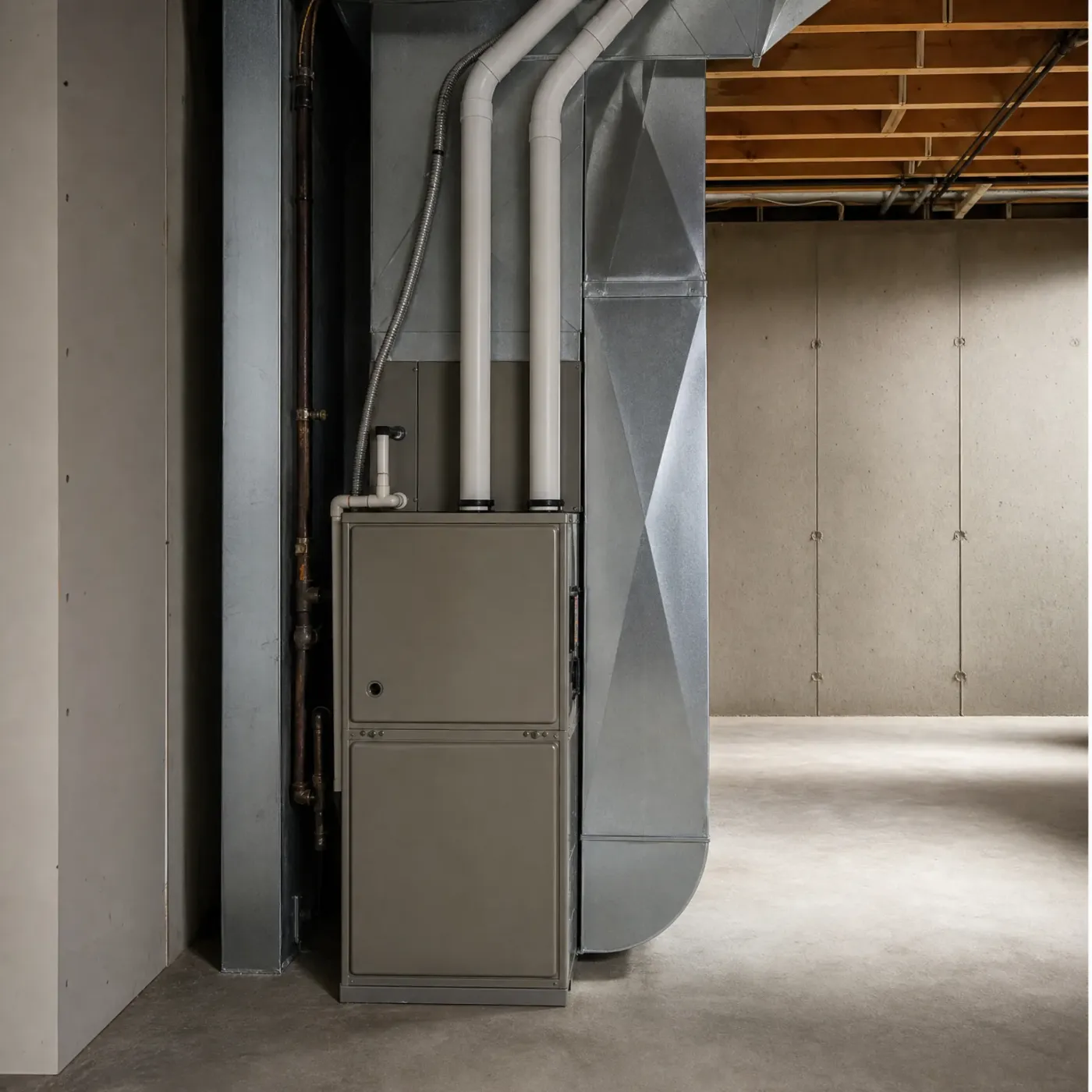
A gray furnace with white PVC vent pipes stands beside sheet-metal ductwork in a basement with a smooth concrete floor, exposed wood framing, and plastic sheeting on the walls.

A furnace still doing its job

This is what a working setup looks like: clean ductwork overhead, tight gas lines, no rust on the cabinet. An oil furnace in this shape is still a candidate for staying as backup in a dual fuel setup instead of getting hauled out.


A beige furnace with two access panels stands against a concrete basement wall, with galvanized sheet-metal ductwork, a white PVC pipe, flexible conduit and insulated ducting around it.

A furnace on its way out

Rust on the cabinet and wear like this usually means the furnace is closer to the end than the middle. That's the point where pairing a heat pump with a new, smaller backup furnace makes more sense than keeping the old one running.

All-Electric or Dual Fuel

All-electric heat pump

  • No oil tank, no oil deliveries, and nothing in the basement burning fuel once the switchover is done.
  • Power in Rhode Island runs expensive, so a heat pump with electric backup strip heat costs more to run on the coldest nights than one backed by oil.
  • The same outdoor unit cools your home all summer, so a sticky July doesn't depend on a separate window unit or an aging central AC.
  • Sizing has to account for the whole winter, not just the mild stretches, since there's no oil furnace left to pick up the hard cold.
  • Removing the oil tank and lines is its own job, on top of the heat pump install itself.

Dual fuel (heat pump plus oil backup)

  • Your oil furnace stays wired in and only fires on the coldest nights, so it's not running all winter the way it does now.
  • You're still buying oil, just a lot less of it, so a delivery or a price spike still touches you, only smaller.
  • The switchover between the heat pump and the furnace happens on its own once it's set up, so you're not choosing which one runs each morning.
  • Keeping the furnace as backup means keeping the oil tank and lines in place, which is one less removal job during install.
  • If the heat pump ever needs service, the furnace is still there to carry the house while that gets sorted out.
A beige residential gas furnace with white PVC vent pipes, copper and yellow gas lines, and adjacent sheet-metal ductwork stands on a concrete floor beside a plain white wall.

Your basement in January

A dual fuel setup still keeps your oil tank and furnace in the basement, so nothing changes there except how often the burner fires. On a 20°F morning, the heat pump outside is doing the work and the furnace stays quiet. It only kicks on below the switchover point you set with the contractor, so oil deliveries should drop, not stop.

A gray high-efficiency furnace with white PVC vent pipes and metal ductwork stands on a concrete floor beside a plain off-white wall in a basement.

Your summer electric bill

You already run AC through a sticky Rhode Island summer, so the outdoor unit isn't new to your yard. What changes is that the same unit heats in winter, and since power here costs more than most states, you're adding electric load during the months you're already paying the most for it. The payoff shows up on the oil side, not by shrinking the summer bill.

A closed silver laptop and a ceramic mug of dark coffee sit on a wooden table in front of two chair backs, with a kitchen counter, tiled backsplash, wooden cutting boards, a vase of greenery and a potted plant by a window behind.

A heat pump with your oil furnace kept as backup is the right call for most Rhode Island homes

Your oil furnace does a job, but it does it at oil prices. A heat pump sized to your home will carry most of the year on its own and only lean on that furnace when it's genuinely cold outside. That's the setup that fits Rhode Island winters without betting everything on electric strip heat when the power bill is already steep.

Getting there means finding a contractor who installs heat pumps and knows how to wire one into an existing oil system, and that search is the part that eats a weekend: looking up licenses, calling around for someone who'll actually show up, explaining your furnace and your ductwork over and over to each one, then sitting with quotes that don't line up. Send the form and that work is off your plate. You'll hear from someone who installs this exact setup, and from there it's a conversation about your house, not a search.

A living room corner with a light beige sofa holding a textured taupe cushion, a large ceramic vase of olive branches by a window, a framed neutral artwork on the wall, and a dark bowl with stacked books in the foreground.
A gray high-efficiency furnace in an unfinished basement, connected to sheet-metal ductwork and two white PVC vent pipes, with copper piping and exposed wood floor joists nearby.

Finding a pro stops being your job

Send my request

Describe the project once instead of to every installer.

Sending the form costs nothing.